Wednesday, 16 April 2014

TO6411 leaves London


Until another possibility comes up TO6411 will come to rest in Queenborough, England. 
On the 10th of April the artist Lucy Wood embarked an a last trip, leaving London behind. 
Hopefully someday the two will return, thus offering more curious onlookers the chance to
encounter their stories and to get a glimpse on what it is like to be traveling under the 
dire conditions set forth by such a small and instable vessel in order to enter the "fortress" of Europe.
 

Monday, 24 March 2014

Another Floating Memory


This video shows the installation "Floating Memory" by French artist Mathilde Roussel-Giraudy. In a way the handkerchiefs of her grandmother remind me of sails floating in the wind and thus deserved a post not only due to the strikingly similar name of the work.

BBC documentary "The Invasion of Lampedusa" (2011)


Sunday, 23 March 2014

The sit-in – reflections from the day after


Yesterday I made my way to the South Dock Lock Office again, this time with a small group from Goldsmiths, to meet Lucy Wood and TO6411 for a second time.
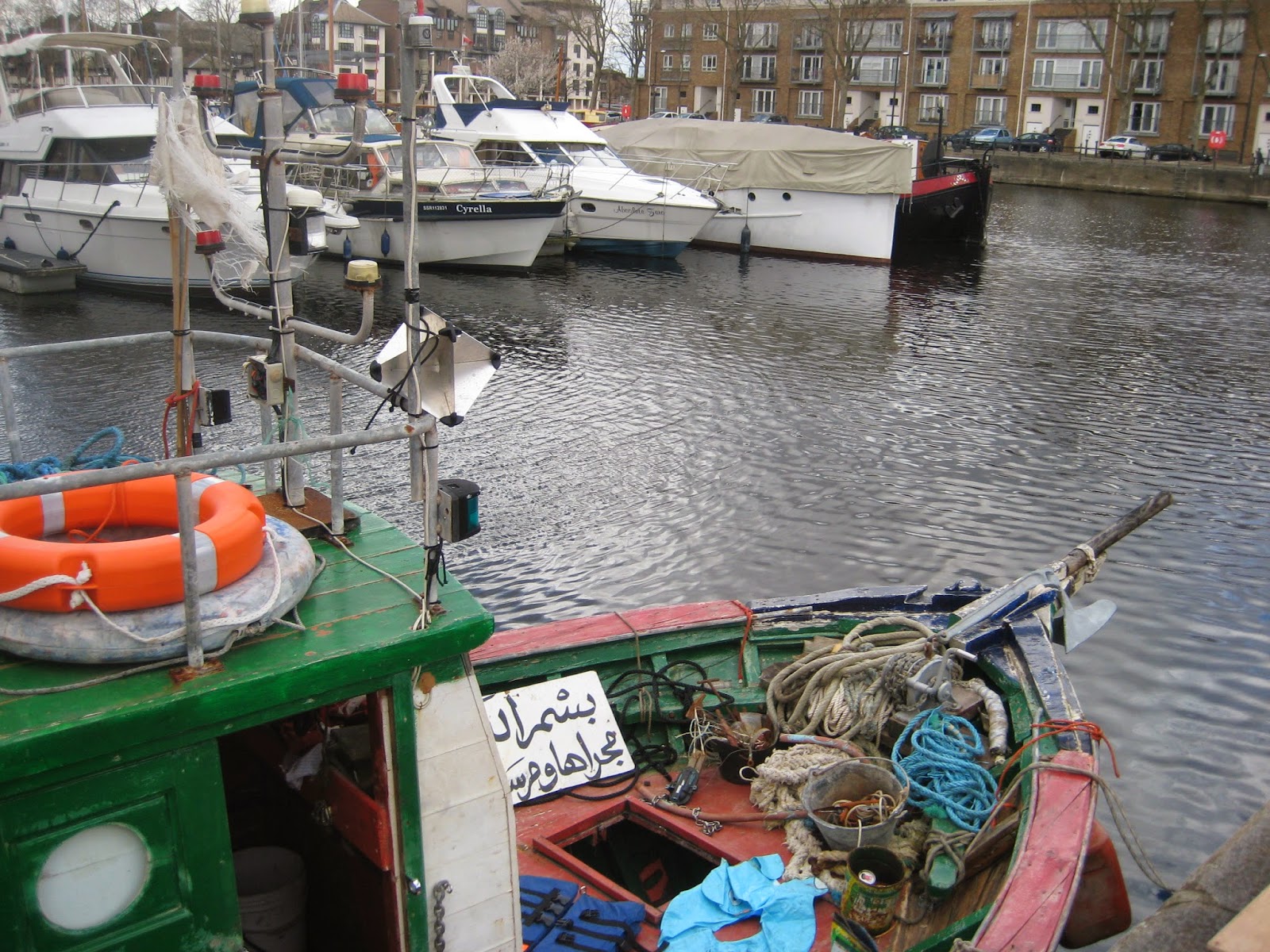
The two had changed places and the boat was now tied up at the rear end of the marina, offering a strong image when entering the marina from the direction of Surrey Quays Station. The contrast of the boat in front of the Canary Wharf Skyline was impressive and reminded one visitor of an image from the recent film “Captain Phillips” (2014) by Paul Greengrass, where a massive American container ship is hijacked by Somali Pirates but is in the end freed by the support of the U.S. Navy – making it ever so clear that as an American you will be protected by your country wherever you are... In an odd way the scene in the South Dock London resembled, as TO6411 strangely feels out of place – there too. Neighbours overlooking the dock were wondering what the attraction of the tiny boat with Arabic writing on it was about, but only a few dared to ask.

This time Lucy Wood had opened the hatches so that we could get a glimpse of the claustrophobic interior of the boat, where some of the 36 migrants had stayed on their journey from Libya to Lampedusa. The smell of the engine, which dates back to 1968 and which would under regular conditions not be in use anymore, is very intense and only with a flash from a camera can one make out the dimensions of the raft as it is very dark down there. How long did they travel? Approximately 2-3 days answers Lucy Wood. What about a toilet break? Silence. The boat is very instable, which one can experience even more when there are several people on it. The only chance of it not tipping over is by holding still and possibly not moving. Even in the safety of the harbour and the more or less still water there we could sense how TO6411 reacted towards our movement.


On deck Lucy had prepared some of the objects she had found on the boat, when she received it from the Italian authorities. Shoes, cassettes, keys, a lighter, cans and other items were assembled and gave a hint towards those who had embarked on the dangerous journey to Lampedusa under the dire conditions of the Libyan uprising in 2011. Lucy Wood was not able to get in contact with the migrants on TO6411 as it is very hard to track them down once they have entered the centre on Lampedusa and also no one is very much interested in such interferences to begin with.
The BBC documentary “The invasion of Lampedusa” (2011) gives a very good impression of the tensions on the Island caused by the “invasion” of thousands of migrants from North Africa, among which some think they arrive on mainland Italy while they are trapped on an island, which does not provide the necessary facilities needed for the masses entering it. Also the tensions that Lucy Wood experienced while she was there become very clear in the documentary where parties with different interests fight against the backdrop of those in need.

Our conversation went on in a Café near by where we learned about the bureaucratic hazards that Lucy had to face when she had eventually arrived in London in October 2013. The organisation of a trip up to Westminster with local politicians and church representatives turned out to be a major problem. Depending on the “cargo” safety regulations suddenly become an issue, as she found out the hard way. This information underlines the absurdity of Wood’s undertaking once more. Who cares for safety regulations when a migrant enters a boat? The tests that were held on TO6411 in order for London MPs to have a safe trip to Westminster led to interesting results. According to there findings a group of seven people would be allowed on the vessel. Compared to 36 who “safely” made their way to Lampedusa, this number seems like a joke. 

When Lucy Wood shared those findings with the local harbour staff in Lampedusa she was being laughed at. Hopefully this laughter can have a reach in the sense that Henri Bergson had in mind when he wrote his essay “Laughter – An essay on the meaning of the comic” (1911; pp. 5,6):
“Laughter appears to stand in need of an echo, listen to it carefully: it is not an articulate, clear, well-defined sound; it is something which would fain be prolonged by reverberating from one to another, something beginning with a crash, to continue in successive rumbling, like thunder in a mountain.” 
Let’s hope for an echo that can possibly change something for those who still enter boats like TO6411 each day. Thank you to Lucy Wood for making this sit-in possible and for sharing your stories and experiences with us and thank you to those who made their way to meet the two memory agents.


Thursday, 20 March 2014

Sit-in on TO6411 on Saturday the 22nd of March with Lucy Wood


The sit-in on TO6411 will finally take place this Saturday at 11AM. The map above indicates
the South Dock Marina Office, where we will meet. The nearest overgroundstation is Surrey Quays and from there it is a 15 minute walk.
I am very glad that Lucy Wood takes the time to host us, the course members of transcultural memory, the MA course led by Astrid Schmetterling and the catalyser of this project, and everyone who is interested in a dialogue with the artist and TO6411. During their trip last year from June to October the refugee boat attracted many curious onlookers. 
I hope that there will be a lively discussion on the boat and afterwards in a café nearby. Looking forward to see many familiar faces. For those who cannot make it the sit-in will be documented here.
 

Monday, 3 March 2014

Constructive Metaphors / Visualizing Memory


The Waters of Lethe, Thomas Benjamin Kennington. Source: http://www.mlahanas.de/Greeks/Mythology/Lethe.html.

Whether we speak of “sites of memory” or “travelling memory”, most attempts to grasp memory inevitably employ metaphors. Citing Harald Weinrich, Astrid Erll claims that “’[w]e cannot conceive of an object such as memory without metaphors. […] (They) are valuable as (hypothetical) cognitive models’”[1] The resulting openness of concepts of memory is both a blessing and a curse.

Metaphors of memory in relation to water appear ubiquitously in the literature concerned with the topic. In “Contemporary Art and Memory” (2007) Joan Gibbons writes: “The idea of ‘places’ in which memory is harboured is central to the work of contemporary French theorist Pierre Nora.” (p. 6) Using the metaphor of the harbour Gibbons doubles the stabilizing effect of the site for memory that Nora stresses. Liedeke Plate even pitched the term of “liquid memories” with regard to sociologist Zygmunt Bauman’s concepts of “liquid times.”[2]

This blog, too, uses a metaphor from the realm of water and sea to bring to light some truth about memory, diasporic memory in particular. The water metaphor indeed goes back to ancient Greece. In the Greek mythology there exist two springs, Lethe on the left (Forgetting) and Mnemosyne (Remembering) on the right.[3] To drink from river Lethe (depicted above in a drawing by T. B. Kennington) means to plunge into the floods of forgetfulness. Unforgetfullness = A-Letheia on the other hand means truth, and is as Heidegger claims the counterpart of forgetting. This is why for me the metaphor of floating memory is so powerful. It implicates both forgetting and remembrance, as both springs from the Greek mythology are evoked and as the truth stems from the river Lethe in the way that Heidegger paves out. 

As highlighted above, the water metaphor also resonates in many academic texts on memory. Again and again one can read about the harbouring of memories and so on and so forth. In this respect, too, is the metaphor a useful visualization for the floating concept of memory. However, as Erll admits, “as a […] ‘whole’ cultural memory is elusive.”[4] Which is why “[r]esearchers can only study discrete acts, or performances of memory.”[5] And this is where (contemporary) art enters the scene.


[1] Harald Weinrich after Astrid Erll. Astrid Erll, Memory in Culture, Palgrave Macmillan, 2011: 96.


[2] Liedeke Plate, Liquid Memories: Women’s Rewriting in the Present, in: Liedeke Plate, Anneke Smelik (Eds.), technologies of memory in the arts, Palgrave Macmillan, 2009: 101.


[3] Francesca Rigotti, Schleier und Fluss – Metaphern des Vergessens (veil and river – metaphors of forgetting [translation MLN]), in: Michael B. Buchholz (Ed.), Metaphernanalyse, Vandenhoek&Ruprecht, 1993: pp. 229-252.


[4] Astrid Erll, Memory in Culture, Palgrave Macmillan, 2011: 104.

[5] Ibid..


Thursday, 27 February 2014

A special encounter - meeting Lucy Wood and TO6411


On Friday the 21.02.2014 I finally had the chance to meet Lucy Wood and TO6411. In bright sunlight I made my way to the South Dock Marina lock office. While waiting, one man of the harbour staff stopped to ask what I was looking for. When I explained whom I wanted to meet he nodded understandingly. "I haven’t seen her this morning.” Apparently the artist and her project are well known at the local port.

The conversation with Lucy Wood turned out to be a real revelation and a great pleasure. Planned as a humanitarian project, the performance piece “Lampedusa to London” is not positioned in the realm of the art world especially, nor is it supposed to be political in an explicit sense. The aim of this was to bring together as much people as possible and to not drive those away who are sceptic or frightened as soon as they hear the word ‘political’, which might remind them of (dangerous) protests and so forth.
The project is self-funded, therefore granting the freedom to experiment and to decide without restrictions from other shareholders. According to the artist one bank approached her and showed interest in the project, but as they asked to put banners along the side of the boat, the artist resigned and chose to realize the project on her own. She did not want it to be used as a promotional tool.

As it was called ‘performance piece’ the stress is obviously on the performative, on the experience that you gain when you are around the two protagonists Lucy Wood and TO6411. When the artist refers to the boat she uses the pronoun “she”, thus putting emphasis on the personal bond they have build during the four months of their travels in 2013, but also proving that the found object TO6411 is regarded as an agent, that is to say a subject in its own right.
During the trip the sit-ins with locals from the 63 stops did not have to be particularly organized because she (TO6411) attracted and amazed passers-by that stopped and started a dialogue with the two memory agents.

What was especially surprising to me were the reactions that Lucy Wood recalled from the local authorities and involved groups on Lampedusa. Initially expecting encouragement or at least good will, the artist was confronted with unthought-of obstacles. For repairing works on the boat Wood would be charged ridiculous prices and when local groups threatened to burn the boat because of fear for the island’s tourism she had to sleep on it even before the journey had started. 

Lucy Wood started exploring migrants and migration flows already in the late 1990s.
The name of the large-scale project “Distant Neighbours” is taken from Mexicans, who used it when referring to Americans, their vecinos distantes. The cumulative and constantly growing piece is planned as a visual book stretching over several projects/chapters over the course of more than one decade.
The first chapter is situated at the border between Mexico and the USA. For her research the dedicated artist moved to the ghost town Ruby, an old American mining town near the border. For the migrants, trying to overcome the border to enter the USA it takes about four days to cross the rocky and dry landscape.
After focusing on the desert in this first chapter, in her following chapters the artist worked with the sea, as a means of travelling and a transmitter of migration flows, which can be just as cruel as the desert.
When she started her trip in June Lampedusa was not so well known at all, which might be a reason for the discouraging reactions of the locals. But by October, when the tragedy had taken place, things suddenly changed. Lampedusa was reported on world-wide and the scope of Lucy Wood’s project seemed somewhat to urgent to be appropriate. Accordingly, the UK media changed their plans to report on the artist’s project due to the recent events. Only belatedly on the 18th of December 2013 there was an event with politicians and church leaders, which were invited by Lucy Wood to go down the Thames to Westminster on World Migrant Day on TO6411.

The boat will be at the South Dock Marina until April. Afterwards Lucy Wood will have her stored somewhere dry until she finds an institution or investor that is willing to take over responsibility.
Till then I want to use the chance and unique opportunity and organize another sit-in with students from Goldsmiths College especially from the course “Transcultural Memory” conducted by Astrid Schmetterling, during the course of which my project  on floating memory arose. The time and place will be announced soon. But it will probably take place on the 15th of March. The Idea is to meet TO6411 and Lucy Wood, to get an idea of the small boat, that initially housed 36 migrants and to start a conversation with the artist about her project and the role of the artist as memory agent in general.
Further details will be announced here.


Sunday, 16 February 2014

First mass border crossing in 2014

The BBC reported yesterday on what has been called the 'first mass border crossing' from North Africa to Spain in 2014. The attempt of hundreds of migrants who tried to swim from Morocco to Spain ended tragically for 14 of them who got shot by rubber bullets from the spanish authorities. Those bullets did not cause their death in the first place, but as a result caused the drowning of the swimmers. 
Spain has repeatedly asked the EU for help in dealing with the migration flow from Africa. Concerning this most recent incident EU Commissioner for Home Affairs Cecilia Malmstrom claimed to be "very concerned". Well, being concerned won't save those who are risking there lives while trying to cross the almost impassable border to Europe.  

Italian navy rescues African migrants in January 2014


This footage from the 03.01.2014 stresses the ongoing crisis and the urgency of the migration and refugee problematic in the Mediterranean.


Saturday, 15 February 2014

Anchoring in a sea of crisis - the artist as memory agent


TO6411 as depicted on Lucy Wood's homepage.


The refugee crisis in the Mediterranean does not seem to find an ending. It was only in the early beginning of this year that 233 migrants were rescued by the Italian navy. According to Navy officials there were men and women from Eritrea, Nigeria, Somalia, Zambia and Mali as well as from Pakistan. Following Reuters the number of sea arrivals from Northern Africa to Italy has tripled in the course of 2013, all told. The urgency that is implied in this report demands for the kind of mediator that Ètienne Balibar has in mind.


At this point I would like to suggest British artist Lucy Wood for this role, who has been engaging with the refugee problematic for the last couple of years. After several visits to the island of Lampedusa she achieved to convince local and national Italian authorities to grant her one of the refugee boats. Together with T06411 (see image above) the artist travelled from Lampedusa to London. During her performance-piece (this name has been given to it by the artist herself) she organized sit-ins with locals from the 63 stops (see map). While navigating the vessel (which had beforehand been put under construction to meet European standards) Lucy Wood supplemented her journey with constant blog entries on the project’s blog “The chronicles of Lampedusa.2013.” Here she reflected on the difficulties and progresses of her project. “Lampedusa to London” is the forth chapter of her “Distant Neighbour”-project.[1] The preceding three chapters had already dealt with migration and displacement – a major concern in the artist’s work.[2] 

With her performance Lucy Wood in a way gives a site to the floating memory of the refugees of the Mediterranean and at the same time she enacts the concept of travelling memory. Within the realm of transcultural memory the notion of “travelling memory” has been pitched by Astrid Erll to capture “the fact that in the production of cultural memory, people, media, mnemonic forms, contents, and practices are in constant, unceasing motion.”[3] Erll argues that literature and art can operate as memory agents, which are actually shaping transcultural memory. With her project “Distant Neighbours” Lucy Wood appears to be precisely such a memory agent.

Another sit-in on T06411 will be organized together with the artist in march 2014, while the boat is still based in London. Further details will be announced here.


[1] When discussing the parable of the Good Samaritan Avishai Margalit argues that “the notion of a neighbour is powerful enough to cross tribal, religious, and ethnic boundaries.” The second part of her project title “neighbour” can thus get over the distance that might geographically separate continental Europeans from the refugees on Lampedusa. Avishai Margalit, The Ethics of Memory, Harvard University Press, 2003: 42.
[2] The first chapter „Vecinos distantes“ (2009) focused on „the migration of Mexicans and Central Americans from Mexico to Arizona USA.” The second and third chapters “Vincini Lontani 2 & 3” already stressed the plight of refugees in the Mediterranean, namely on Lampedusa. The information is taken from the artist’s project homepage: http://www.to6411.net/artist.html (last visit: 03.01.2014).
[3] Astrid Erll, Travelling Memory, in: Parallax, vol. 17, no. 4, 2011: 12.

Thursday, 30 January 2014

Border/Boundary


“A boundary is not that at which something stops but, as the Greeks recognized, the boundary is that from which something begins its essential unfolding.”[1]
(Martin Heidegger, 1951)
Since the implementation of the Schengen Area into the European Union (EU) in 1999 the EU nurtures the “free movement of people, goods, services, and capital.”[2] On the official homepage it states, that “[i]t is an area without internal borders, an area within which citizens, many non-EU nationals, business people and tourists can freely circulate […].“[3] This area creates an open space for the circulation of goods and people. Passport controls at borders have been abolished within the Schengen Area. According to Paul Gschrey “the border structures are expected to dissolve, give way and to facilitate movement – but not all travellers are welcome.”[4] This is a crucial point. The travelling among Europeans has indeed become easier. When travelling by car or train, one does not even have to realize the crossing of a border. However for non-European travellers and especially illegal migrants, the borders have almost become impassable barriers: “In attempts to reduce the potential risk to the European Community the hazards for irregular migrants increase” constantly.[5]
 
Étienne Balibar even introduces the idea of “the Great Wall of Europe under construction,” separating the European continent from its North African ‘neighbours’.[6] Thinking of the hundreds of refugees, whose journeys towards the European Union end tragically each year, the European border, indeed, seems to be a boundary at which something stops, in allusion to the opening citation by Martin Heidegger. What unfolds are the inequalities which we are facing on our borders today. Borders are semipermeable – for some easy to pass by, for others almost impossible to overcome. It is this inequality that makes contemporary borders worth rethinking. And it is in this thinking about borders, in the discourse and activism engaging with borders, that something unfolds its (essential) being. In engaging with borders we challenge them and question the inequalities they make us face and which are inacceptable. 

The question that arises is as follows: how can borders be mediated and controlled in order to diminish (recent) inequalities? What is at stake here according to Étinne Balibar is “the operation of the ‘border’, (which) […] illustrate[s] the relationship between politics and violence.”[7] The border itself is operating, because someone operates it by exploiting it. Operators such as the European Border Surveillance System (Eurosur) or the European Agency Frontex may come to mind.[8] In order to prevent the ‘fortress’ of Europe from potential risks, these agencies function as radical border controlling systems, putting forth the inequalities of our borders. 

However, the abolishment of borders does not seem to offer a solution. According to Balibar, a borderless “’world’ would run the risk of being a mere arena for the unfettered domination of the private centres of power which monopolize capital, communications and, perhaps also, arms.”[9] It is quite easy to imagine companies such as Facebook or Google, constantly accumulating knowledge about us and our online-behaviour, to exercise their power in a way paved out by Balibar. Our focus should thus turn to the operators of our borders, “states and supranational institutions”, and possible systems of controlling them:[10] “It is a question […] of what democratic control is to be exerted on the controllers of borders.”[11] At the end of his essay, Balibar hints at who such controllers might be: “Now, […] one most often needs interpreters, mediators.”[12]


[1] Martin Heidegger, Building, Dwelling, Thinking (1951), in: David Farrell Krell (Editor), Martin Heidegger, Basic Writings, from Being and Time (1927) to The Task of Thinking (1964), Routledge, 2011: p. 250.
[2] This and more information on the contents of the Schengen Convention are available online: http://europa.eu/legislation_summaries/internal_market/ – last visited on 30.10.2013.
[3] This statement is taken from the section concerning borders and visas on the official EU homepage: http://ec.europa.eu/dgs/home-affairs/what-we-do/policies/borders-and-visas/
index_en.htm – last visited on 01.11.2013.
[4] Paul Gschrey, Tracing Borderlines: Shifting European Borders and Migratory Movement, in: John Hutnyk (Editor), Beyond Borders, Pavement Books, 2012: p. 171.
[5] Paul Gschrey, Tracing Borderlines: Shifting European Borders and Migratory Movement, in: John Hutnyk (Editor), Beyond Borders, Pavement Books, 2012: p. 176.
[6] Étienne Balibar, Strangers as Enemies. Further Reflections on the Aporias of Transnational Citizenship (2006), in: Globalization and Autonomy, http://www.globalautonomy.ca/global1/
article.jsp?index=RA_Balibar_Strangers.xml – last visited on 10.11.2013: p. 3.
[7] Étienne Balibar, Politics and the Other Scene, Verso, 2002: p. xi.
[8] Compare: Paul Gschrey, Tracing Borderlines: Shifting European Borders and Migratory Movement, in: John Hutnyk (Editor), Beyond Borders, Pavement Books, 2012: pp. 175,176.
[9] Étienne Balibar, What is a Border?, in: Étienne Balibar, Politics and the Other Scene, Verso, 2002: p. 85.
[10] Ibid.
[11] Ibid.
[12] Ibid.


Filling the gap


In his text “Remembering, Repeating and working-through” (1914) Freud claims that the job of the psychoanalyst is to fill the gaps of the patients memory (see p. 147/148). As I am my own patient and analyst at the same time (and in a way this holds true for Freud as well – his dream analysis was indeed based on his own dreams…) I have to deal with the gap of my memory work on this blog myself.

Since the last and first entry there has been a gap of almost two months. In the meantime I had already written a second entry but I felt some kind of blockade to actually post it. Why could I not post a follow up text? 


The only way of overcoming this blockade seems to me to address my problem publicly – here. As this blog is an experiment I decided finally to give in to my doubts and to engage with the issues that I am struggling with. Mainly – who am I to engage with a topic such as refugee memory? This question grew so big in my head that it let to some kind of helplessness and eventually to me not posting anything anymore.

I have grown up in this bourgeois and safe middle class environment and am fully aware of it. And even the divorce of my parents (though indeed it means the loss of a feeling of being “home”) could never compete with the experience of being forced to leave ones home country due to civil wars or other kinds of unbearable situations. Nevertheless I tried to unavailingly relate myself to the subject that I am addressing, which is most obvious in the first entry. 


As the question of ‘why me’ let to the incapacity of writing about refugee memory I decided to keep my issues in mind but to skip the question to the end of the experiment. In fact it does not really matter who engages with the question, as I think that it is important to engage with it in the first place which is more relevant. Maybe the reach of these entries will stay quite private. Maybe it is my personal engagement with refugees and floating memory and maybe that is ok. 

But even if the stakes are not that high this does not mean that this experiment is not worth a try. And as Hans-Jörg Rheinberger has pitched with the notion of the “epistemic thing”, you never know the outcome of something right from the start (of course he would have put this in much more elaborate words). Work in progress.